Questions & answers

Car park ventilation with jet fans

How jet fan (impulse) ventilation works in enclosed car parks, how jet fans are selected and which AEROMIS series cover the job. All product figures on this page are counted from the AEROMIS product database.

What does a jet fan do in a car park?

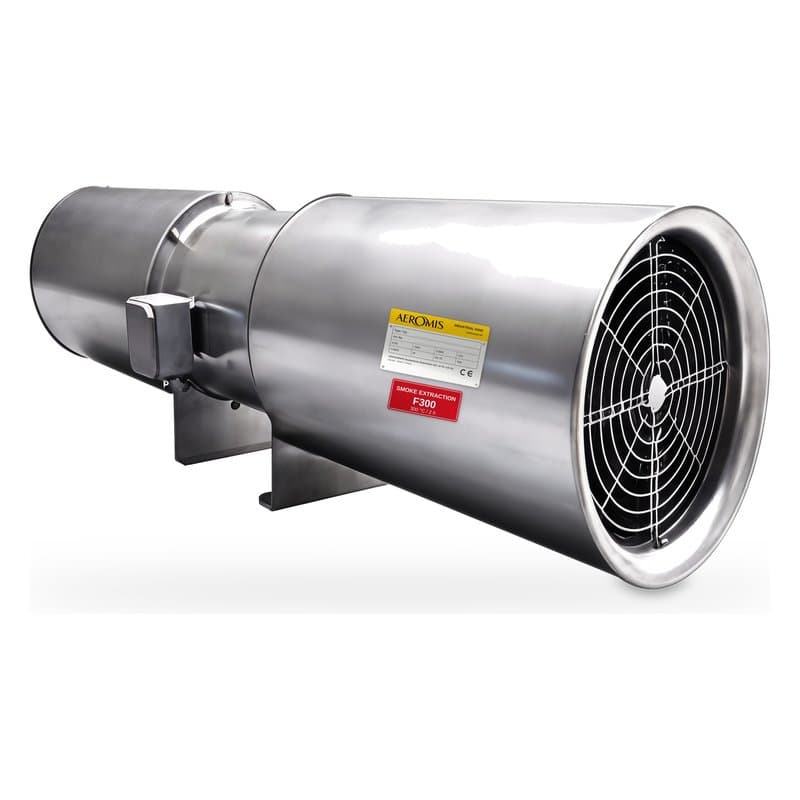
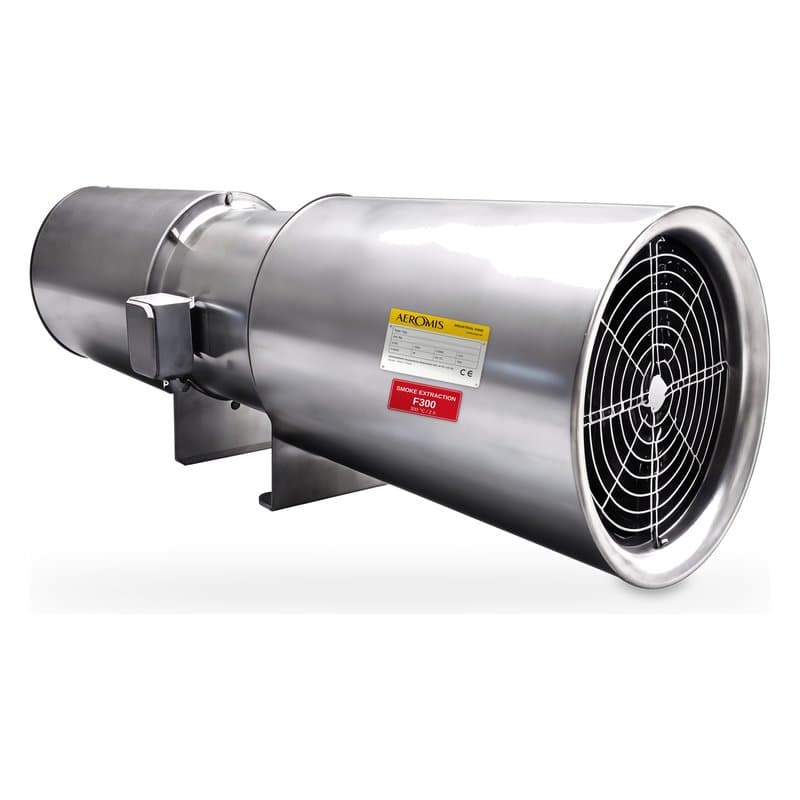
A jet fan hangs under the car park ceiling and pushes the air with a fast, concentrated jet. The jets carry polluted air – or smoke in a fire – towards the extract points, so the long sheet-metal duct runs of a ducted system are not needed. Jet fans do not bring fresh air in or take air out of the building themselves: the main supply and exhaust fans at the shafts do that.
How is a jet fan selected?

By thrust, in newtons (N), not by an airflow–pressure duty point, because a jet fan does not work against a duct system. How many fans are needed and where they go depends on the geometry of the car park, the ceiling height and beams, and the position of the extract points; the layout is normally checked by the system designer with a CFD study. AEROMIS jet fans cover 6–152 N with impeller diameters from Ø315 to Ø630 mm.

What do F300 and F400 mean?

They are temperature classes for fans that must keep running during a fire to remove smoke. In the AEROMIS database 16 jet fan models are rated 300 °C for 2 hours (F300) and 16 models 400 °C for 2 hours (F400). Which class a project needs is decided by the local fire regulations and the fire-engineering design.

Why are jet fans two-speed?

Low speed is used for day-to-day ventilation, usually switched by the CO detection system; high speed is used for smoke control. All 32 AEROMIS jet fan models are two-speed.

Which other fans does a jet fan system need?

The main smoke exhaust fans that remove the air from the building. AEROMIS has 144 smoke exhaust fan models in F300 and F400 classes for in-line, wall and roof installation, with airflows up to 157,593 m³/h.

How do I get a selection or a quotation?

Compare the jet fans by thrust in the AEROMIS fan selector, or send us the car park drawings and the required thrust through the contact form. Detailed datasheets are available to registered members.